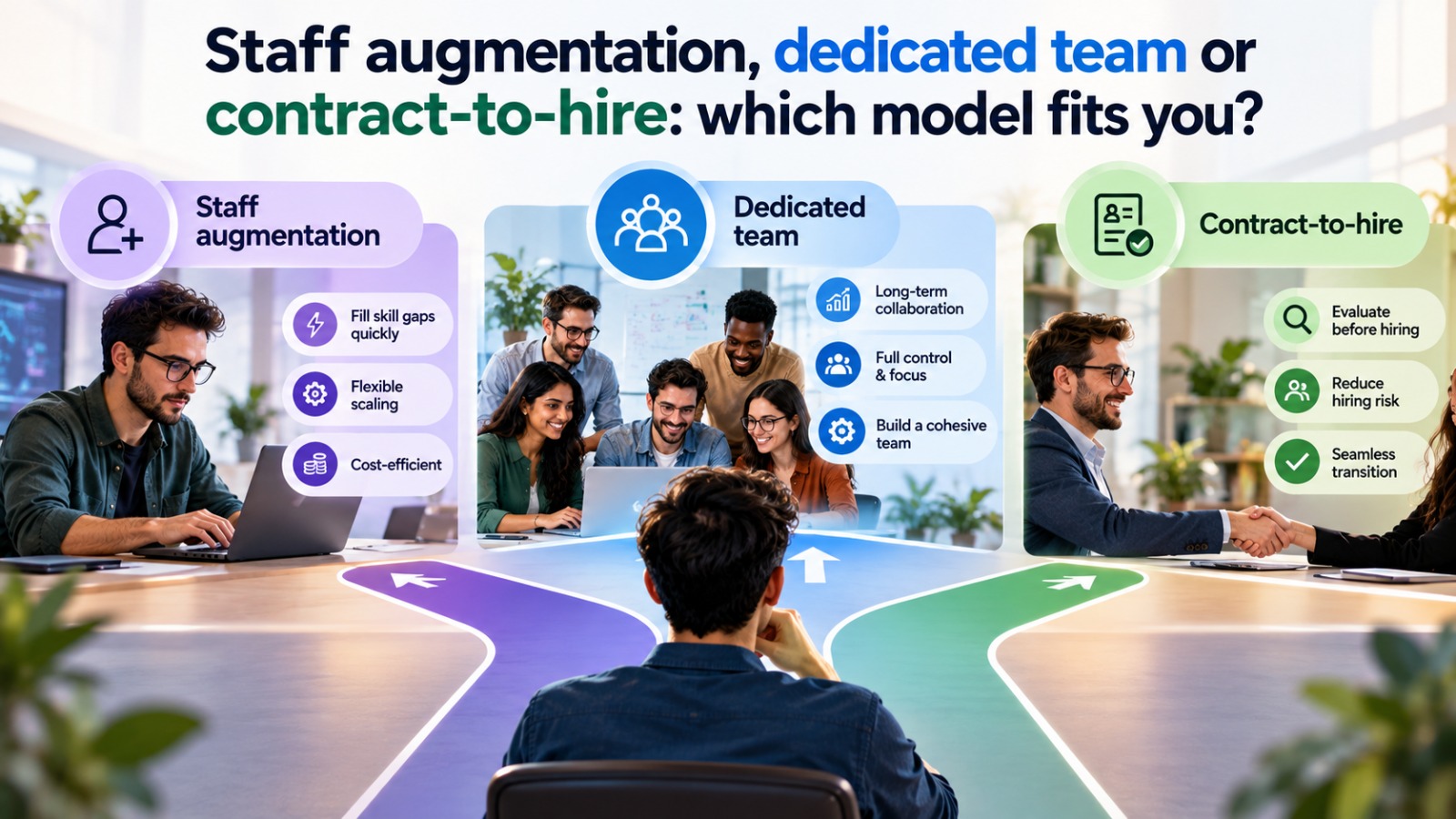
Growing a team isn’t one-size-fits-all. Some businesses need a single specialist for a few months. Others need a full pod to build a product. Others want to be sure about a hire before committing.
Here’s how three common models compare, so you can choose with confidence.
1. Staff augmentation
What it is: Individual specialists added to your existing team, from one person upward.
Best for:
- Filling a specific skill gap, such as a QA engineer, a DevOps specialist or a support agent
- Meeting a deadline without a long recruitment process
- Adding capacity during busy periods
Keep in mind: You direct the day-to-day work, so you’ll want a manager or lead available to guide it.
2. Dedicated team
What it is: A managed pod of roughly 3 to 10 people who work together as one unit.
Best for:
- Building or running a whole product, workstream or department function
- Projects that need several skills working side by side
- Leaders who want an outcome rather than a headcount
Keep in mind: A dedicated team works best with a clear scope and a regular rhythm of reviews.
3. Contract-to-hire
What it is: You work with a professional first, then convert them to your own payroll later.
Best for:
- Roles where fit matters as much as skill
- Teams that want to see the work before committing
- Businesses planning to build their own in-house team over time
Keep in mind: Plan the conversion timeline up front so everyone knows what to expect.
How to choose
| If you need… | Consider |
|---|---|
| One or two specific skills, quickly | Staff augmentation |
| A full team to own an outcome | Dedicated team |
| Confidence before a permanent hire | Contract-to-hire |
Many companies start with one model and move to another as they grow. Begin with a single professional, expand into a pod, and convert key people to your payroll when the time is right.
The takeaway
The best hiring model is the one that matches where your business is today and leaves room to change tomorrow. Flexibility is what keeps growth from turning into overhead.